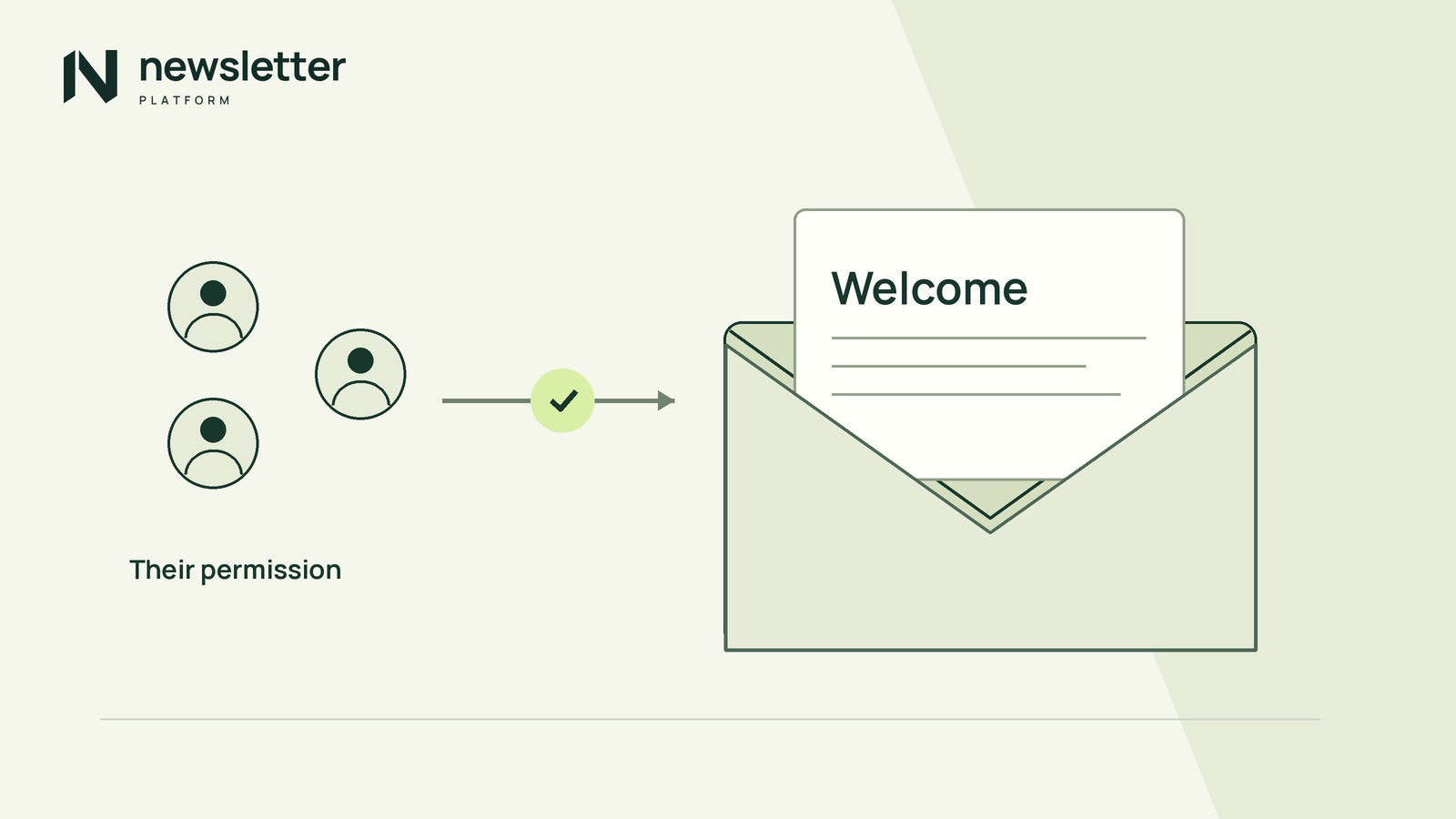
Include past customers in a permission-based newsletter only when their recorded signup covers your planned message and no active suppression applies. A suppression is a sending block, such as a recorded unsubscribe or do-not-contact instruction.
A purchase, a “subscriber” tag or a successful import is not enough. Use three outcomes: supported for this newsletter, held for missing or mismatched permission, and excluded because of active suppression. Decide before importing records as newsletter subscribers or selecting an audience.
This is a conservative audience policy, not universal legal clearance. Seek qualified advice if you intend to rely on a legal exception instead of an opt-in.
Define the newsletter’s purpose
Write down the sender, topics, promotional content and intended frequency. Do not describe an offer email as “care advice” merely because it includes a useful tip.
Retrieve the wording shown when each person signed up. Today’s form cannot establish last year’s promise, and an archived form alone does not show that a particular person opted in.
Follow this if/then decision path
Compare each address across the relevant sources, and resolve gaps or conflicts before marking it supported. If you discover an active suppression, mark it excluded even if it was previously held.
First: if an active suppression exists, exclude
Check the signup list, any previous sending service and separately kept unsubscribe or do-not-contact records. Mark known active blocks excluded, even if an earlier newsletter opt-in exists. An export without suppression fields is not evidence that nobody opted out.
Otherwise: if permission or history is incomplete or mismatched, hold
Look for evidence of the person’s opt-in action, tied to the signup source, date and original wording. If confirmation was required by that signup process, check that it was completed, not merely sent. Confirmation does not broaden the original promise.
Mark the record held if evidence is absent, the promise does not cover this newsletter, or relevant histories are missing or conflict. Record what evidence or fresh opt-in would resolve the hold.
Only with matching permission and reconciled history: supported
Mark supported for this newsletter only when the promise covers its sender, content and frequency, and the suppression review finds no active block or unresolved gap. This is permission eligibility, not approval to send.
TRY THE SCENARIOS
Which plant-shop records belong in this newsletter audience?
Hypothetical plant shop planning “Monthly plant-care tips and shop offers.” For each stated signup, the action, date and original wording are documented, and any required confirmation is complete. Relevant histories have been checked across sources; only P-03 has an active block.
P-01: an order without newsletter signup evidence
Held: the order does not establish permission. Find a separate matching signup record; otherwise keep this address held pending a fresh opt-in.
P-02: a confirmed restock-only signup
Held: confirmation does not extend the restock-only promise to this newsletter. Find separate newsletter permission or offer a fresh on-site signup covering care tips and offers.
P-03: a matching signup followed by an active unsubscribe
Excluded: the later unsubscribe blocks the earlier permission. Preserve the suppression and leave this address out of the audience.
P-04: a matching signup with no suppression or history gap
Supported for this newsletter: the recorded promise matches the monthly care-and-offers plan. Record the evidence and pass this address to separate pre-send checks, not directly to sending.
Compare all scenarios
| Situation | What happens |
|---|---|
| P-01: an order without newsletter signup evidence | Held: the order does not establish permission. Find a separate matching signup record; otherwise keep this address held pending a fresh opt-in. |
| P-02: a confirmed restock-only signup | Held: confirmation does not extend the restock-only promise to this newsletter. Find separate newsletter permission or offer a fresh on-site signup covering care tips and offers. |
| P-03: a matching signup followed by an active unsubscribe | Excluded: the later unsubscribe blocks the earlier permission. Preserve the suppression and leave this address out of the audience. |
| P-04: a matching signup with no suppression or history gap | Supported for this newsletter: the recorded promise matches the monthly care-and-offers plan. Record the evidence and pass this address to separate pre-send checks, not directly to sending. |
Illustrative examples. Your selection is not saved or sent, and changes no store settings.
Record a completed decision in a private ledger
Use one entry per address in a restricted-access spreadsheet or similar record. Match the same address across sources; do not transfer permission because names look alike. Retain the underlying evidence.
Here is a completed hypothetical P-04 entry; no real address is shown:
- Contact reference: P-04; the same address was checked across all reviewed sources.
- Permission evidence: The signup log records the person selecting an initially unchecked newsletter box on 4 March 2026, tied to the archived wording “Monthly plant-care tips and shop offers.” Confirmation, required in this example, was completed that day.
- Message fit: The same shop is sending monthly care tips and offers, matching the recorded promise.
- Suppression review: On 12 March 2026, the reviewer checked the signup list against the previous service’s unsubscribe export and separate do-not-contact log. No active blocks, conflicting events or missing sources were found.
- Decision and next action: Supported for this newsletter; reviewed by fictional Reviewer A on 12 March 2026. Match the selected audience to the ledger, recheck later opt-outs and complete separate pre-send checks before scheduling.
Use the same fields for held and excluded records, recording their reason and next action.
Resolve holds without emailing the unverified list
If permission covering this newsletter cannot be verified, keep the record held. Offer a clear, voluntary signup on your website for returning visitors, naming the sender and describing the newsletter’s content and frequency.
Do not email the unverified export to ask for permission as a workaround. Fresh permission is a new event, not evidence of historical consent. Review any new signup against suppression history too.
For an actively suppressed address, review any later signup through an appropriate resubscription process. Keep the record excluded while the block remains active; never clear it just to finish an import.
Check the selected audience before handing it off
Preserve necessary suppression information during any move between systems, following the destination’s documented process. Permission review does not replace sending checks, and mail-transport acceptance does not prove inbox delivery.
Review every proposed address, then match the selected recipients to supported ledger entries. Check for later opt-outs, remove duplicates and leave out every held or actively suppressed address. Then review the final message and sender setup, inspect a received test email and verify unsubscribe behavior before scheduling.